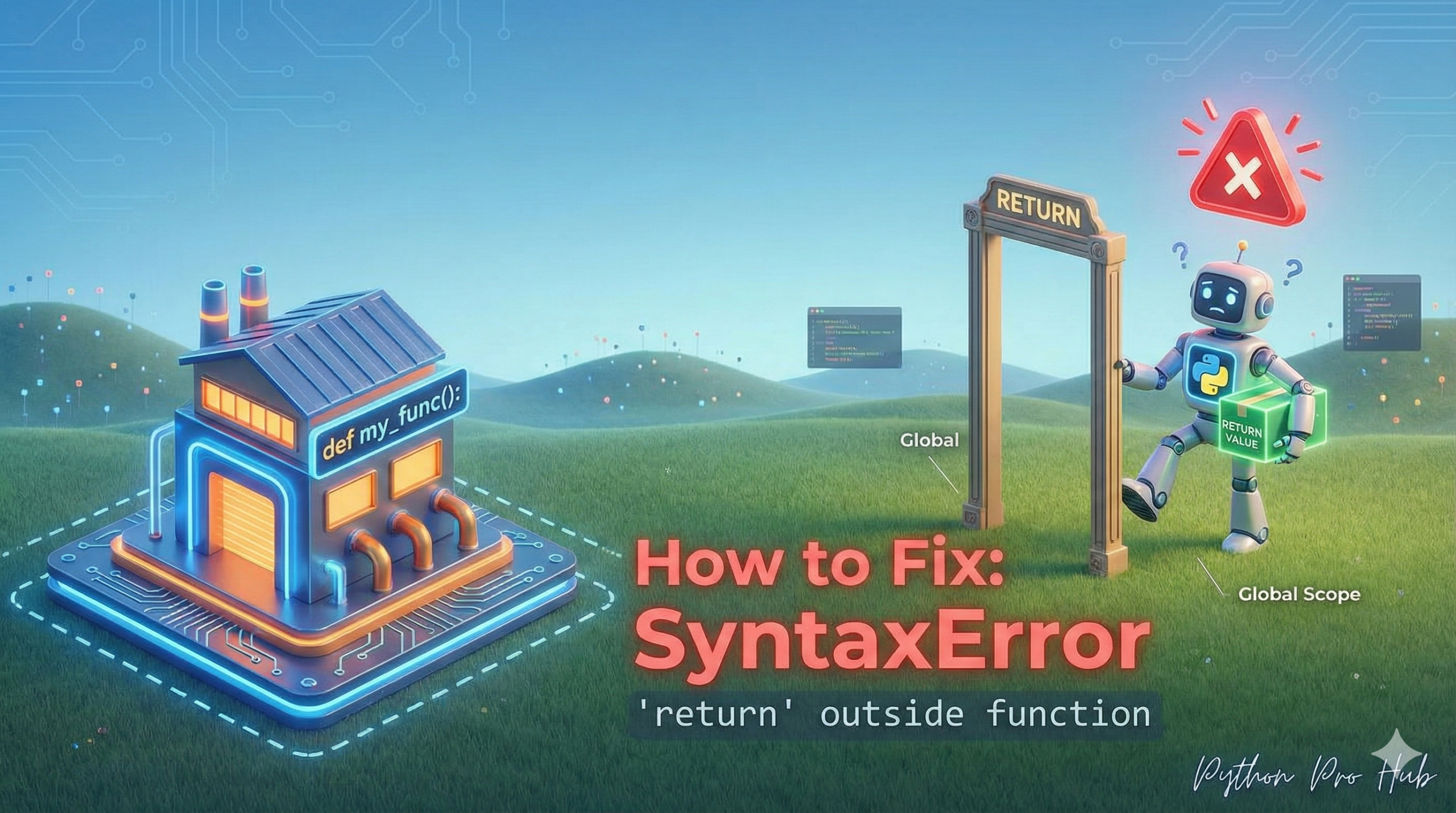
This SyntaxError return outside function is SyntaxError that means you’ve misunderstood the purpose of the return keyword.
The error message is very literal: You used return, but you are not inside a function.
⚡ Quick Fix: SyntaxError: ‘return’ outside function (Python return Keyword Scope Fix)
Python hit a return statement with no function above it to return from — the keyword has no valid scope to exit.
# Fix 1 — You just want to see the value: use print()
x = 10
if x > 5:
    print(x)  # Output: 10

# Fix 2 — You want to exit a loop: use break
for i in range(10):
    if i == 5:
        break  # Stops the loop cleanly

# Fix 3 — You actually need to return a value: wrap it in a function
def check_value(x):
    if x > 5:
        return x
    return 0
The snippets above cover the three patterns that trigger this error — the rest of the article walks you through how to identify which one matches your code.
The Cause
The return keyword has one job: to exit a function and pass a value back. If you use it at the “top level” (also called the “global scope“) of your script, it has no function to exit from and no “caller” to return a value to.
Problem Code:
x = 10
if x > 5:
    return x # CRASH!

print("Done")
Error: SyntaxError: 'return' outside function
You are trying to return from the if statement, but if is not a function.
The Fix
You need to ask yourself what you were trying to do.
Fix 1: You meant to print the value
If you just want to see the value, use print(), not return.
x = 10
if x > 5:
    print(x) # Correct!

print("Done")
Fix 2: You meant to break out of a loop
If you are in a loop and want to stop, use break.
for i in range(10):
    if i == 5:
        break # Correct! (Stops the loop)
    print(i)
Fix 3: You forgot to wrap it in a function
If you really meant to return the value, you need to wrap your code in a function.
def check_value(x):
    if x > 5:
        return x # Correct! (Returns from the function)
    return 0

result = check_value(10)
print(result)
What This Error Exposes About Python’s Execution Model
SyntaxError: ‘return’ outside function is one of the few Python errors the interpreter catches before it runs a single line — it fails at the parse stage, not at runtime. That matters because it means no amount of conditional logic or runtime state can hide it. Python reads your file top to bottom as a syntax tree, and a bare return in the global scope is structurally invalid regardless of what surrounds it.
The three root causes map directly to three different mental models. Developers who come from languages where scripts have implicit entry points sometimes treat the top-level file as a function body — it is not. Developers building loops reach for return when they mean break because both feel like “stop what you’re doing.” Developers refactoring code extract logic out of a function but leave the return behind, orphaned at the module level.
The architectural takeaway: return is a function contract, not a general-purpose exit tool. If your code needs to stop a loop, break owns that job. If it needs to output a value to the terminal, print() owns that job. Reserve return exclusively for functions that pass a computed value back to a caller — that boundary enforces clean, predictable code structure across your entire codebase.