The AttributeError str join is a message you’ll often see in Python programming. This error is a simple but common typo.
AttributeError: ‘str’ object has no attribute ‘join’ means: “You tried to call the .join() method on a string, but you misspelled it.”
⚡ Quick Fix: AttributeError: ‘str’ object has no attribute ‘jion’ – Python str.join() Typo and Syntax Fix
You misspelled .join() — and even with the correct spelling, the method belongs to the separator string, not the list.
my_list = ["Hello", "world"]

# Fix 1 — Correct spelling: separator.join(list)
result = " ".join(my_list)       # Output: Hello world

# Fix 2 — Any string can be the separator
result = ".".join(["file", "txt"])  # Output: file.txt

# Fix 3 — Empty string joins with no separator
result = "".join(["a", "b", "c"])   # Output: abc
This tells you exactly where your boundary is — now read through the root causes below to find which one broke your code and fix it permanently.
The Cause
You have a typo in the method name. Problem Code:
my_list = ["Hello", "world"]
separator = " "

# You have a typo in the method name
separator.jion(my_list) # 'jion' instead of 'join'
# CRASH! AttributeError: 'str' object has no attribute 'jion'
Note: This error is often confused with AttributeError: 'list' object has no attribute 'join', which is a different problem.
The Fix: Check Your Spelling
The method is spelled j-o-i-n.
The Correct .join() Syntax
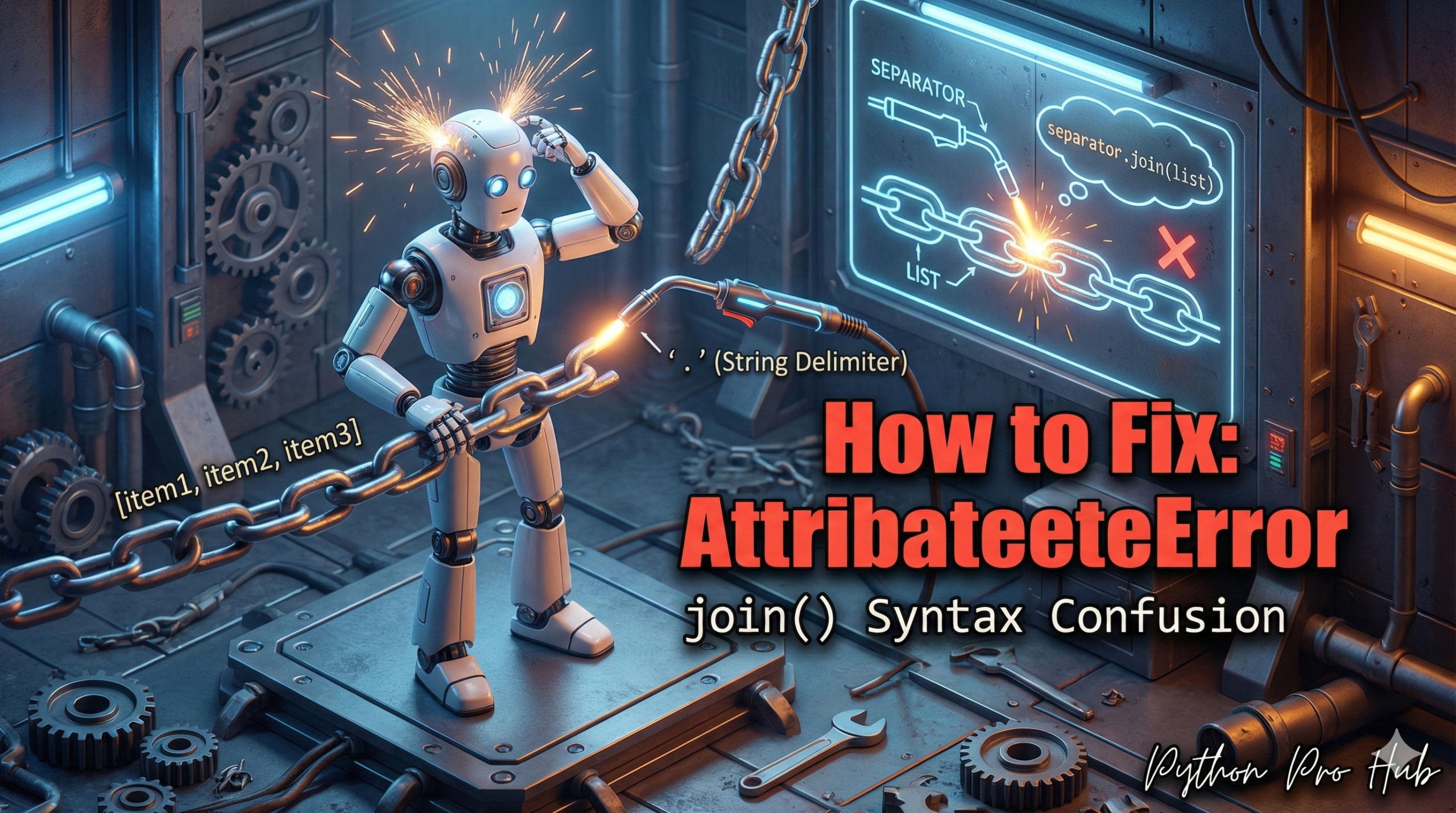
This is the part that confuses beginners. The .join() method is called by the separator, not by the list.
The Syntax: separator_string.join(list_of_strings)
Correct Code:
my_list = ["Hello", "world"]

# The separator is the space " "
separator = " "

# Call .join() ON the separator string
result = separator.join(my_list)

print(result)
# Output: Hello world
Another Example:
my_list = ["file", "txt"]
separator = "."
result = separator.join(my_list)
print(result)
# Output: file.txt
What This Error Exposes About Python’s str.join() Design
AttributeError: 'str' object has no attribute 'jion' is Python’s attribute lookup returning a clean miss on a misspelled method name — but the deeper confusion this error surfaces is about .join()‘s inverted syntax. Every beginner’s instinct says my_list.join(" ") — the list is the thing being joined, so call the method on the list. Python’s design says the opposite: the separator owns the method and receives the list as an argument.
The design decision is intentional and consistent with Python’s string protocol. .join() lives on str because the separator controls the output format — it iterates the list, pulls each element through its own string context, and inserts itself between each pair. Placing the method on str also enforces a type contract: .join() only accepts iterables of strings. Pass a list containing an integer and Python raises TypeError: sequence item 0: expected str instance, int found immediately, before any concatenation runs.
The performance implication of .join() matters for production code. String concatenation with + inside a loop creates a new string object on every iteration — for a list of N items, that produces N intermediate string allocations. .join() pre-calculates the total output length, allocates one string object, and writes all items into it in a single pass. For lists with hundreds or thousands of elements, the memory and speed difference is measurable. Build the habit of reaching for "separator".join(list) as the default string assembly tool and reserve + for cases where you are combining two or three strings at most.