
Handling Nested Data in Polars: explode() and unnest()
Real-world data from APIs often comes as nested JSON. Pandas struggles with this, but Polars has two powerful expressions built for it: explode and unnest….
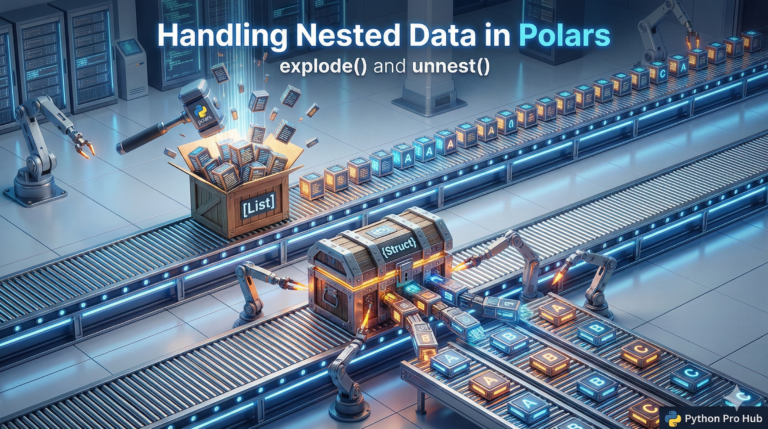
Real-world data from APIs often comes as nested JSON. Pandas struggles with this, but Polars has two powerful expressions built for it: explode and unnest….

Text data is almost always messy. One of the most efficient ways to tackle this is with Polars string manipulation. In Pandas, you use .str…
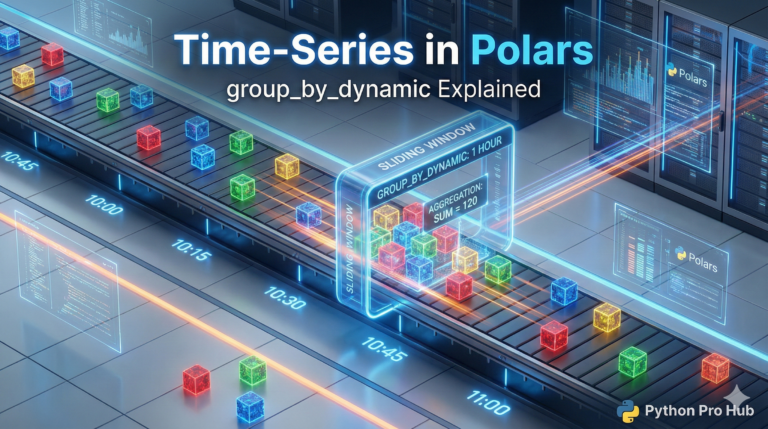
One of the most common tasks in data analysis is “resampling” time data. For example, turning a list of daily sales into “Total Monthly Sales.”…

Just like Pandas has NaN, Polars has null to represent missing or empty data. Before you can analyze a dataset, you must have a strategy…

The most common data analysis task is “Split-Apply-Combine.” When using Polars, the groupby operation is essential for this task. In Polars, this is done with…

In Pandas, you use pd.merge() to combine datasets. In Polars, you use the join() method, which is one of the fastest in any library. If…

In our Polars vs. Pandas article, we showed that Polars is faster. The reason it’s faster is its Expression API. In this article, we’ll take…

You’ve learned how PyScript can run Python in a browser and how to interact with the page. Now, let’s do something powerful. In this article,…

You’ve used Pandas. You’ve read our Intro to Polars. Now, let’s answer the big question: “Why should I switch, and how hard is it?” This…

For years, Pandas has been the undisputed king of DataFrames. But as datasets have grown into 10s or 100s of gigabytes, a new tool has…