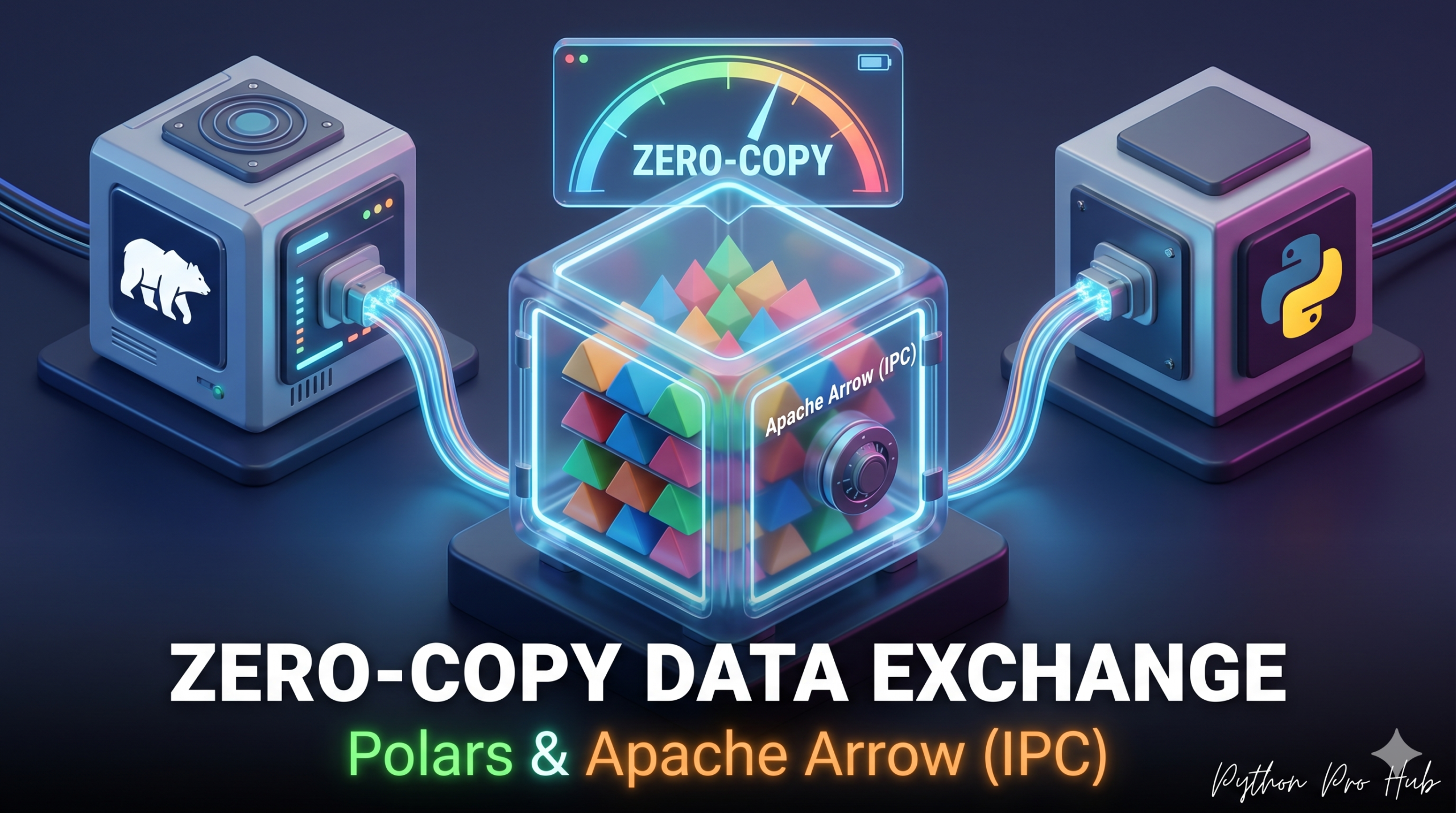
The secret to Polars’ speed isn’t just Rust; it’s Apache Arrow.
Arrow is a standard memory format. Because Polars uses Arrow internally, it can send data to other Arrow-compatible tools (like PyArrow, DuckDB, or even R) without copying it. This is called “Zero-Copy.”
⚡ Quick Fix: Polars Apache Arrow Zero-Copy and IPC Format
df.to_arrow() and pl.from_arrow() convert between Polars and PyArrow without copying memory. write_ipc() / read_ipc(memory_map=True) saves and loads the raw Arrow buffer from disk — no deserialization overhead.
import polars as pl

# Zero-Copy interop
arrow_table = df.to_arrow()
df_back = pl.from_arrow(arrow_table)

# IPC: instant disk round-trip
df.write_ipc("data.arrow")
df_fast = pl.read_ipc("data.arrow", memory_map=True)
The full breakdown below covers when to use IPC over Parquet and how zero-copy interop works with PyArrow and DuckDB.
1. Polars to PyArrow (and back)
If you need to use a library that requires PyArrow tables, you can switch instantly.
import polars as pl
import pyarrow as pa

# Create a Polars DataFrame
df_pl = pl.DataFrame({"a": [1, 2, 3], "b": [4, 5, 6]})

# 1. To PyArrow Table (Zero-Copy!)
arrow_table = df_pl.to_arrow()

print(type(arrow_table))
# Output: <class 'pyarrow.lib.Table'>

# 2. Back to Polars (Zero-Copy!)
df_back = pl.from_arrow(arrow_table)
2. The IPC (Feather) File Format
Parquet is great for storage (compressed). IPC (Inter-Process Communication), also known as Feather, is great for speed. It saves the raw memory dump to disk. It is uncompressed but loads instantly.
# Write to IPC (Feather)
df_pl.write_ipc("data.arrow")

# Read from IPC (Memory Mapped!)
# 'memory_map=True' means it opens instantly, reading bytes only when needed
df_read = pl.read_ipc("data.arrow", memory_map=True)
When to use IPC?
- Parquet: Long-term storage (smaller size).
- IPC/Arrow: Short-term storage (passing data between scripts, saving temp files).
Polars Apache Arrow Zero-Copy Eliminates the Serialization Bottleneck Between Tools
Zero-copy only holds when both sides speak Arrow natively — Polars, PyArrow, and DuckDB all qualify, so conversions between them stay allocation-free. Passing data to a library that doesn’t support Arrow (NumPy, scikit-learn) breaks zero-copy and triggers a full memory allocation; use .to_numpy() explicitly so that cost is visible in your code rather than hidden inside a conversion call. For IPC files, memory_map=True defers actual byte reads until a column is accessed — a 2 GB file opens in milliseconds because Polars maps the file into virtual address space without loading it. Set memory_map=False only when the file lives on a network drive where random-access reads are slower than a sequential full load.
Key Takeaways
- Polars’ speed relies on Apache Arrow, a standard memory format that enables Zero-Copy data transfer between compatible tools.
- Using Polars, you can switch to PyArrow tables instantly when needed, improving flexibility.
- The IPC (Inter-Process Communication) format, also known as Feather, offers fast read times, making it suitable for short-term storage.
- Zero-Copy works effectively with Polars, PyArrow, and DuckDB, preventing memory allocation when transferring data between them.
- For IPC files, using memory mapping allows swift access, loading large files in milliseconds; avoid it on network drives unless necessary.