
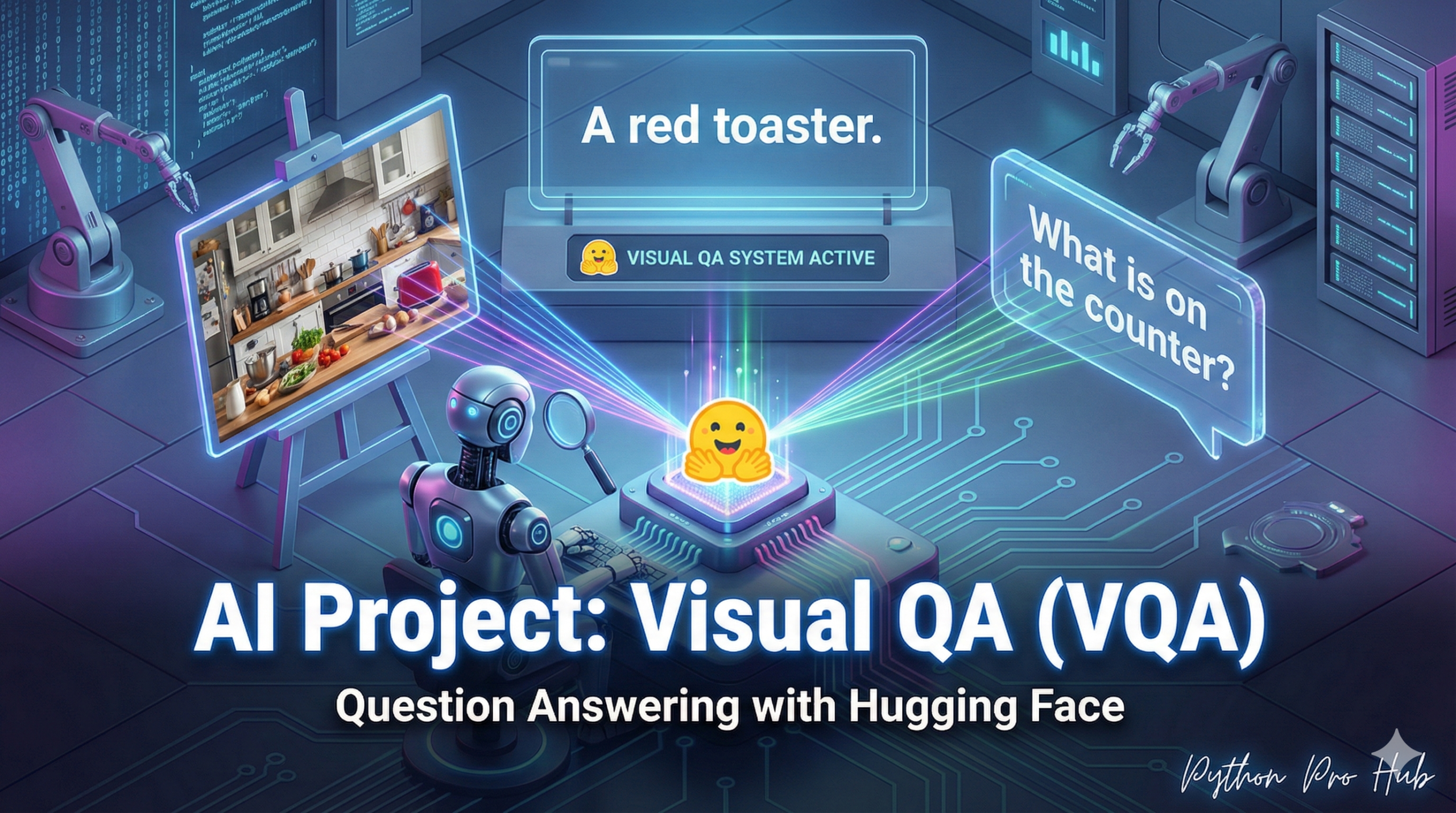
This is a true “2026 Vision” project. Hugging Face VQA is at the core of what we’re building—we’re giving our AI eyes and a brain.
Visual Question Answering (VQA) is a task where the AI model looks at an image and answers a question you ask about it in plain English. This combines Computer Vision and NLP.
Step 1: Installation
You’ll need Pillow to handle images and timm.
pip install transformers torch pillow timm
Step 2: The Code
We use the visual-question-answering pipeline. You provide the model with both an image and a question.
from transformers import pipeline
from PIL import Image
import requests

# 1. Load the pipeline
# This will download a VQA model
vqa_pipeline = pipeline("visual-question-answering")

# 2. Get an image
url = "http://images.cocodataset.org/val2017/000000039769.jpg" # (The image of two cats)
image = Image.open(requests.get(url, stream=True).raw)

# 3. Ask a question about the image
question = "How many cats are in this image?"

# 4. Run the VQA model!
results = vqa_pipeline(image=image, question=question)

# 5. Print the results
print(f"Question: {question}")
print("--- Answers ---")
for result in results:
    print(f"Answer: {result['answer']} (Score: {result['score']:.4f})")
Step 3: The Result
The model will analyze the image and give you the most likely answers.
Question: How many cats are in this image?
--- Answers ---
Answer: 2 (Score: 0.9981)
Answer: two (Score: 0.0015)
Answer: 1 (Score: 0.0001)
It correctly identified there are two cats! You can ask other questions like, “What color is the remote?” or “What are the cats sitting on?”
Key Takeaways
- The project, called ‘2026 Vision’, aims to enhance AI with visual perception and reasoning abilities.
- Visual Question Answering (VQA) combines Computer Vision and NLP to allow AI to interpret images and answer questions about them.
- To implement Hugging Face VQA, install the necessary libraries Pillow and timm.
- Use the ‘visual-question-answering’ pipeline to provide images and questions to the model.
- The model can analyse images and accurately identify objects, like recognizing two cats in a scene.