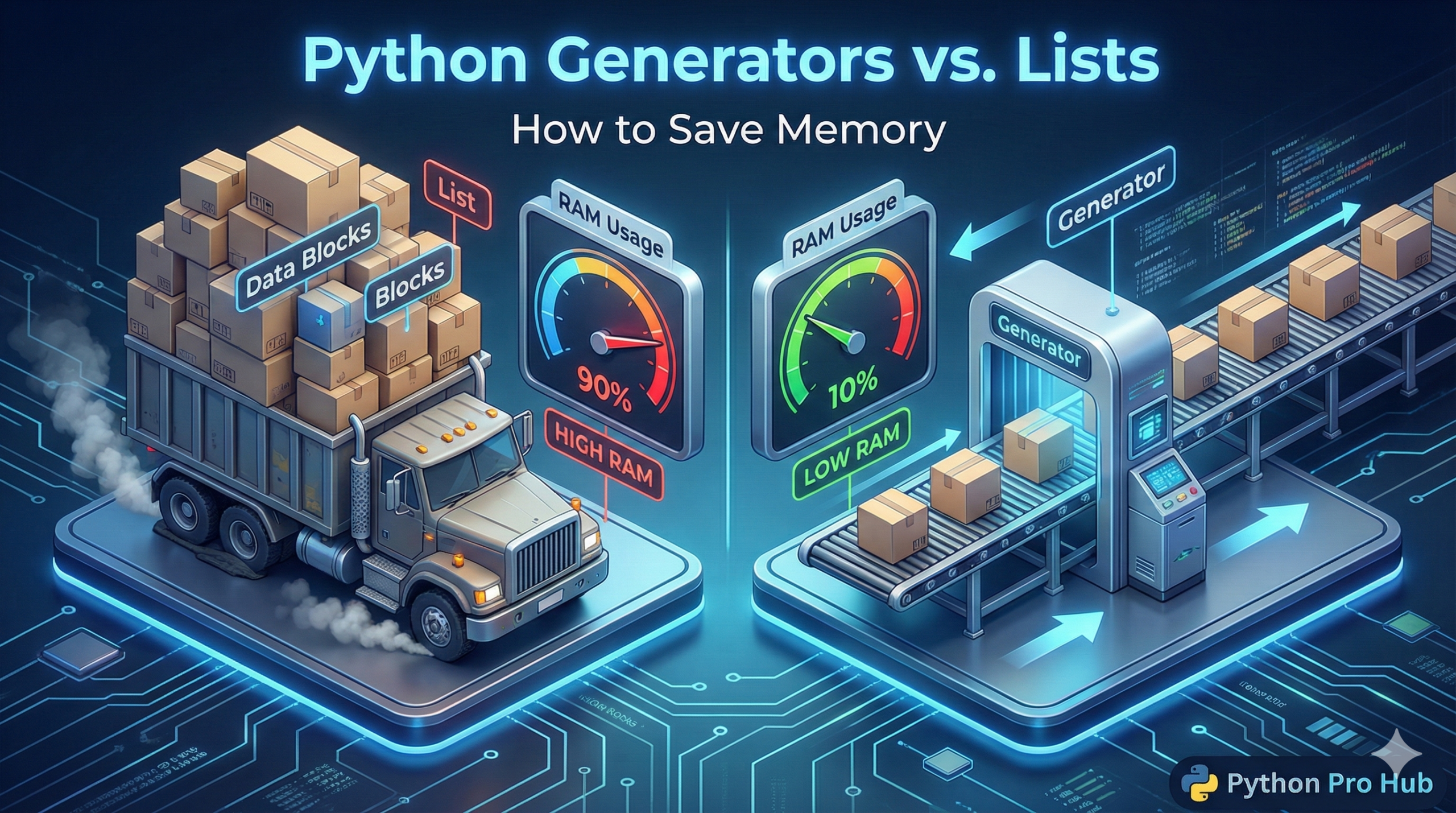
Imagine you need to process 1 billion numbers. If you create a List of 1 billion numbers, Python has to create all of them at once and store them in RAM. Your computer will likely crash. This is where Python Generators come in handy. Using a generator allows you to generate values on the fly without occupying too much memory.
A Generator is smarter. It doesn’t create them all at once. It creates them one at a time, only when you ask for them. This is called “lazy evaluation.”
The Visual Difference
- List:
[1, 2, 3, 4, 5](All in memory now) - Generator: A recipe that knows how to get the next number, but hasn’t done it yet with the use of Python generators.
How to Make a Generator (yield)
Instead of return, a generator function in Python uses yield.
def normal_list_function(n):
    result = []
    for i in range(n):
        result.append(i * i)
    return result

def generator_function(n):
    for i in range(n):
        yield i * i  # Pause here and give back one value
The Memory Test
Let’s prove it.
import sys

# A list of 1 million squares
my_list = [i * i for i in range(1000000)]
print(sys.getsizeof(my_list))
# Output: ~8.6 MB of RAM

# A generator of 1 million squares (using () instead of [])
my_gen = (i * i for i in range(1000000))
print(sys.getsizeof(my_gen))
# Output: ~120 Bytes of RAM!
The generator is thousands of times smaller because it doesn’t store the data; it just stores the rules to create it. Python generators efficiently manage memory usage.
When to Use Them
Use generators when:
- You are working with a massive dataset (like reading a huge file line-by-line).
- You don’t need to access items randomly (e.g., you don’t need
data[500]), you just need to loop through them once while employing Python’s generators.
Key Takeaways
- Python Generators allow you to generate values one at a time, saving memory compared to using a complete List.
- Generators use ‘yield’ instead of ‘return’, enabling lazy evaluation and efficient memory management.
- They are significantly smaller as they store rules to create data rather than the data itself.
- Use Python Generators when dealing with large datasets or when you do not need random access to items.