🚀 Welcome to Your New Superpower
Welcome to your one-stop guide for learning Python. If you’re a complete beginner feeling overwhelmed, you’re in the right place. Alternatively, if you’ve tried before and it didn’t “click,” this guide is for you.
Python is consistently ranked as the most loved and in-demand programming language in the world. Why? It’s readable, powerful, and has a massive community. In fact, you can use it for everything from Web Development (Netflix, Instagram) to Data Science (NASA, Spotify) and Automation (doing your boring work for you).
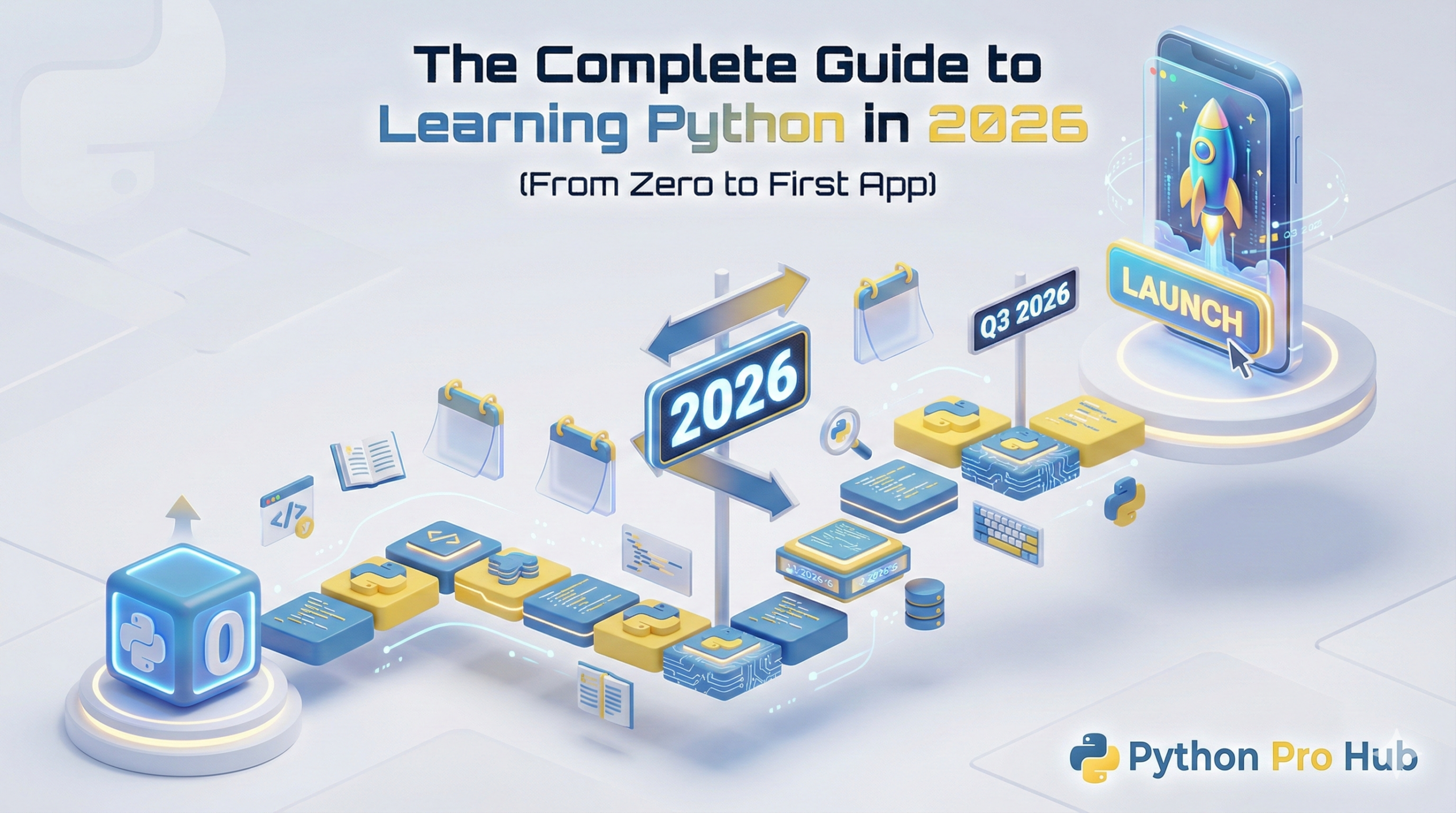
This guide is a roadmap. Specifically, it is designed to take you from “What is Python?” to writing your very first useful application.
Table of contents
🛠️ Part 1: Your Python Setup (The 10-Minute Install)
Before you can run, you need to walk. Therefore, let’s get your environment set up correctly.
1. Installing the Engine
First, you need the Python interpreter—the “brain” that reads and executes your code.
- Download: Go to python.org/downloads and get the latest stable version (e.g., Python 3.12+).
- Windows Users (CRITICAL): Run the installer and check the box that says “Add Python to PATH”. Consequently, this makes it accessible from your command line.
- Mac/Linux: You likely have Python installed, but it might be old. We recommend installing the latest version via the official installer or Homebrew (
brew install python3).
2. Choosing Your Editor (VS Code)
You can write Python in Notepad, but you shouldn’t. Instead, you need an IDE (Integrated Development Environment).
- Recommendation: Visual Studio Code (VS Code). It is free, fast, and the industry standard.
- The Secret Weapon: Once installed, go to the “Extensions” tab and install the official Python extension from Microsoft. As a result, this gives you color-coding and error checking instantly.
3. The “Virtual Environment” (Crucial)
Most tutorials skip this, but we won’t. To avoid breaking your system, you should always create a “sandbox” for your projects.
- Why use it? Learn why “Dependency Hell” happens and how
venvfixes it. Python Virtual Environments (venv): A Beginner’s Survival Guide
🧱 Part 2: Python’s Core Concepts (The Foundation)
This is where you’ll spend 80% of your time. Consequently, you must master these building blocks.
1. Variables & Data Types
Think of a variable as a labeled box where you store information. Python needs to know if that box holds text (String), whole numbers (Integers), or decimals (Floats).
- Naming Rules: The rules of naming. Learn why
user_nameis good but2namecauses a crash. Python Variables & Data Types: A Beginner’s Deep Dive - Data Behavior: Understanding how Python handles data in memory is crucial. Specifically, knowing the difference between mutable and immutable objects. Mutable vs. Immutable Objects in Python: Why It Matters
2. Control Flow (Making Decisions)
Your code needs to make choices. For example, if X happens, do Y. If not, do Z.
- Error Handling: Even the best code crashes. Therefore, learn to catch errors gracefully using
tryandexceptblocks. Python Try-Except Blocks: Handling Errors Gracefully - Context Managers: The cleaner way to manage resources. Stop manually closing files and use the
withstatement. Python Context Managers: The Magic Behind the with Statement
3. Loops (Repetition)
Don’t copy-paste code. Instead, use loops to perform actions 1,000 times in a millisecond.
- For Loops: The workhorse. Use for loops to iterate over lists and data. The Ultimate Guide to Python ‘for’ Loops and ‘while’ Loops
- Comprehensions: The cleaner way. Furthermore, use List Comprehensions to replace 5 lines of loop code with 1 line. Python List Comprehensions: Writing Cleaner Code
4. Functions (Reusable Actions)
A function is a saved recipe. You define the steps once, and then “call” it whenever you need it.
- DRY Principle: Don’t Repeat Yourself (DRY). Learn how to define functions with
def. How to Write Your First Python Function (A Beginner’s Guide) - Lambdas: Advanced functions. Specifically, using Lambda functions for quick, one-line logic. Python Lambda Functions: Anonymous Functions Explained
📦 Part 3: Data Structures (Organizing Info)
Real apps manage data. Therefore, you need to know how to store lists of users, dictionaries of settings, and tuples of coordinates.
Collections
- The Big Three: Learn the difference between a List (changeable), a Tuple (permanent), and a Dictionary (key-value). Python Lists vs. Tuples vs. Dictionaries: A Beginner’s Guide
- Dictionaries: The key-value store that powers almost every Python program. Also, learn how to handle missing keys. How to Fix: KeyError in Python (Dictionaries and Pandas)
🏗️ Part 4: Object-Oriented Programming (OOP)
This is the leap from “Scripting” to “Engineering.” Ultimately, OOP lets you model real-world objects (like a User or a Product) in code.
Classes & Objects
- The Blueprint: Understanding Classes, Objects, and
__init__. Object-Oriented Programming (OOP) in Python: A Beginner’s Guide to Classes and Objects - Magic Methods: Make your classes behave like built-in types using
__str__and__len__. Python Dunder Methods: What init and str Really Mean
🎮 Part 5: Your First Projects
You can only learn so much from theory. Ultimately, the real learning happens when you build something.
- Project 1: The Number Guessing Game. Start here to learn to handle random numbers and user input loops. Beginner Python Project: Build a Number Guessing Game
- Project 2: The Calculator. Subsequently, build a robust tool that handles math and “Division by Zero” errors. Python Beginner Project: Build a Simple Calculator
🗺️ Conclusion: Choose Your Path
Once you master these basics, the world splits into three paths. Which one will you choose?
- Web Development: Build the backend of websites with Flask and Django.
- Data Science: Analyze the world with Pandas and AI.
- Automation: Build bots to do your boring work with Scripts.
💡 Frequently Asked Questions About Learning Python in 2026
Generally, you can learn the basics of Python in 2 to 6 weeks. However, mastering advanced, job-ready topics like Web Development (Django) or Data Science (Polars) will take several months of consistent, daily practice.
Absolutely. Python is widely considered the best programming language for beginners. Because its syntax reads remarkably like plain English, you can focus on learning core coding concepts rather than memorizing complex, confusing symbols.
No, you do not need an expensive laptop. In fact, Python is highly efficient and runs perfectly fine on older computers, basic Windows/Mac laptops, or even a $50 Raspberry Pi.
You should always learn Python 3. Specifically, aim to download the latest stable release (such as Python 3.12 or higher) from the official python.org website, as Python 2 is now completely obsolete and unsafe.
Currently, Visual Studio Code (VS Code) is the absolute industry standard. It is free, lightweight, and features an official Python extension that highlights your errors and auto-completes your code instantly.