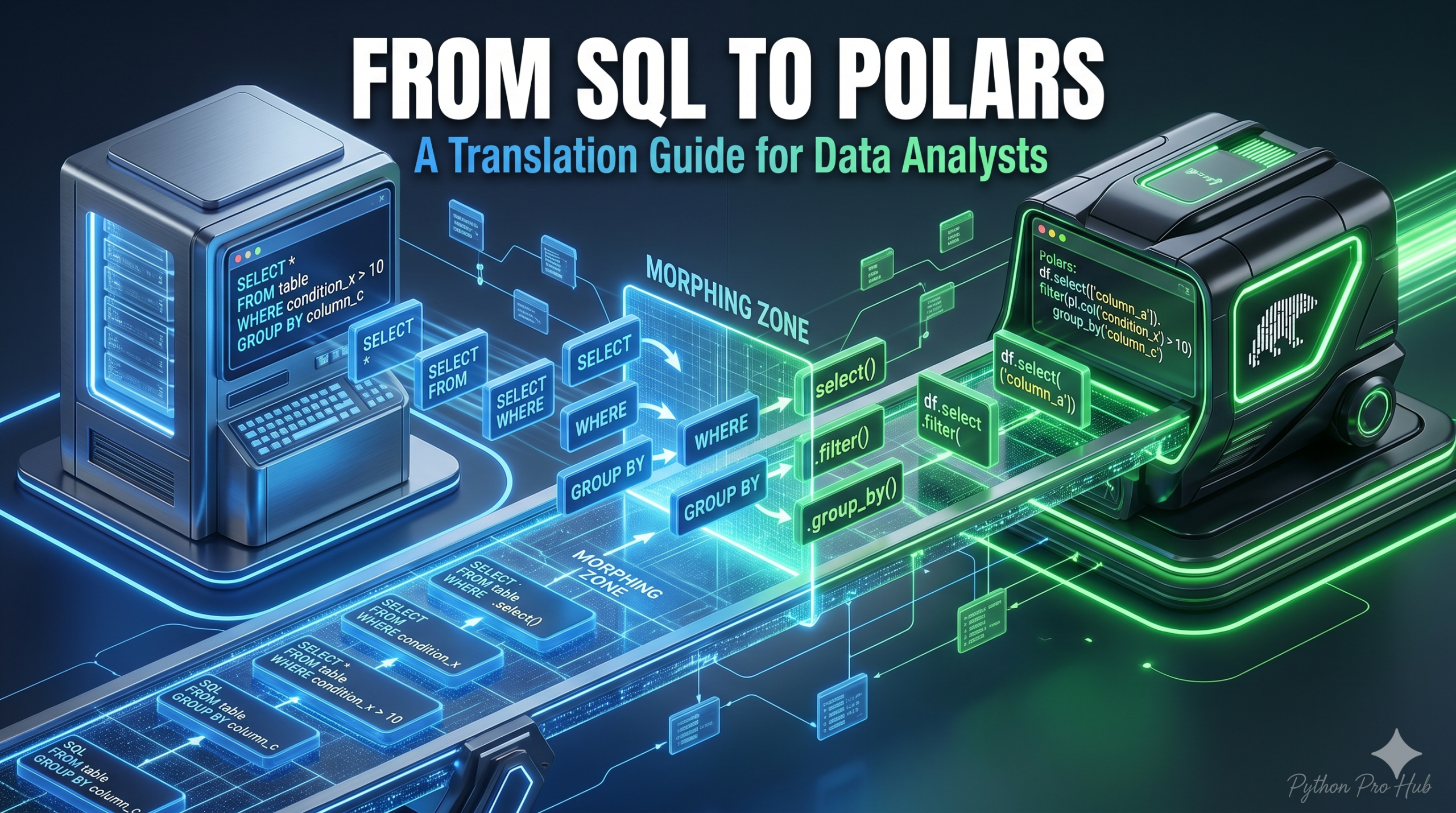
If you already know SQL, you fundamentally understand how Polars operates. Unlike Pandas, which forces you into an imperative, row-by-row mindset, Polars is built on declarative expression trees. It optimized execution plans under the hood exactly like a relational database management system (RDBMS).
When you write Polars code, you aren’t telling the engine how to loop through data; you are defining what data matrix you want to construct. Here is your definitive translation cheat sheet for mapping SQL logic to production-grade Polars.
1. SELECT and AS (Renaming)
In Polars, .select() handles column pruning and allocation. To rename an expression output on the fly, chain the .alias() method.
SQL:
SELECT col_a, col_b AS new_name FROM df;
Polars:
import polars as pl

df.select([
    pl.col("col_a"),
    pl.col("col_b").alias("new_name")
])
2. WHERE (Row Filtering)
Filtering rows uses the .filter() method. Polars evaluates filters optimizing predicate pushdown, meaning it reads only the rows satisfying these conditions during lazy execution scans.
SQL:
SELECT * FROM df WHERE col_a > 10 AND col_b = 'X';
Polars:
df.filter(
    (pl.col("col_a") > 10) & (pl.col("col_b") == "X")
)
3. GROUP BY and Aggregates
Polars splits aggregation into two steps: grouping context (.group_by()) and evaluation context (.agg()). You can run multiple complex aggregations in parallel inside the .agg() list.
SQL:
SELECT category, SUM(sales) AS total_sales
FROM df
GROUP BY category;
Polars:
df.group_by("category").agg(
    pl.col("sales").sum().alias("total_sales")
)
4. HAVING (Filter after GroupBy)
SQL requires a distinct HAVING clause because of its strict evaluation order. In Polars, query compilation is linear. To filter post-aggregation, simply chain another .filter() block directly to your statement.
SQL:
SELECT category, SUM(sales) AS total_sales
FROM df
GROUP BY category
HAVING total_sales > 1000;
Polars:
df.group_by("category").agg(
    pl.col("sales").sum().alias("total_sales")
).filter(
    pl.col("total_sales") > 1000
)
5. WINDOW Functions (OVER Partition)
Window functions allow you to compute aggregations across groups without collapsing the DataFrame rows. In Polars, this is elegantly achieved by adding .over() directly to an expression inside a .with_columns() block.
SQL:
SELECT sales,
       SUM(sales) OVER (PARTITION BY category) AS category_total
FROM df;
Polars:
df.with_columns(
    pl.col("sales").sum().over("category").alias("category_total")
)
Polars essentially is a super-fast, programmable SQL engine.
Key Takeaways
- Polars operates on declarative expression trees, unlike Pandas’ row-by-row approach, making it similar to an RDBMS.
- To translate SQL logic to Polars: use .select() for column pruning and .filter() for row filtering with optimized predicate pushdown.
- Aggregation in Polars involves .group_by() and .agg(), allowing multiple complex aggregations to run in parallel.
- Post-aggregation filtering in Polars happens by chaining .filter() directly to the statement, rather than using a HAVING clause.
- Polars supports window functions by adding .over() within a .with_columns() block, maintaining DataFrame rows while computing aggregations.