
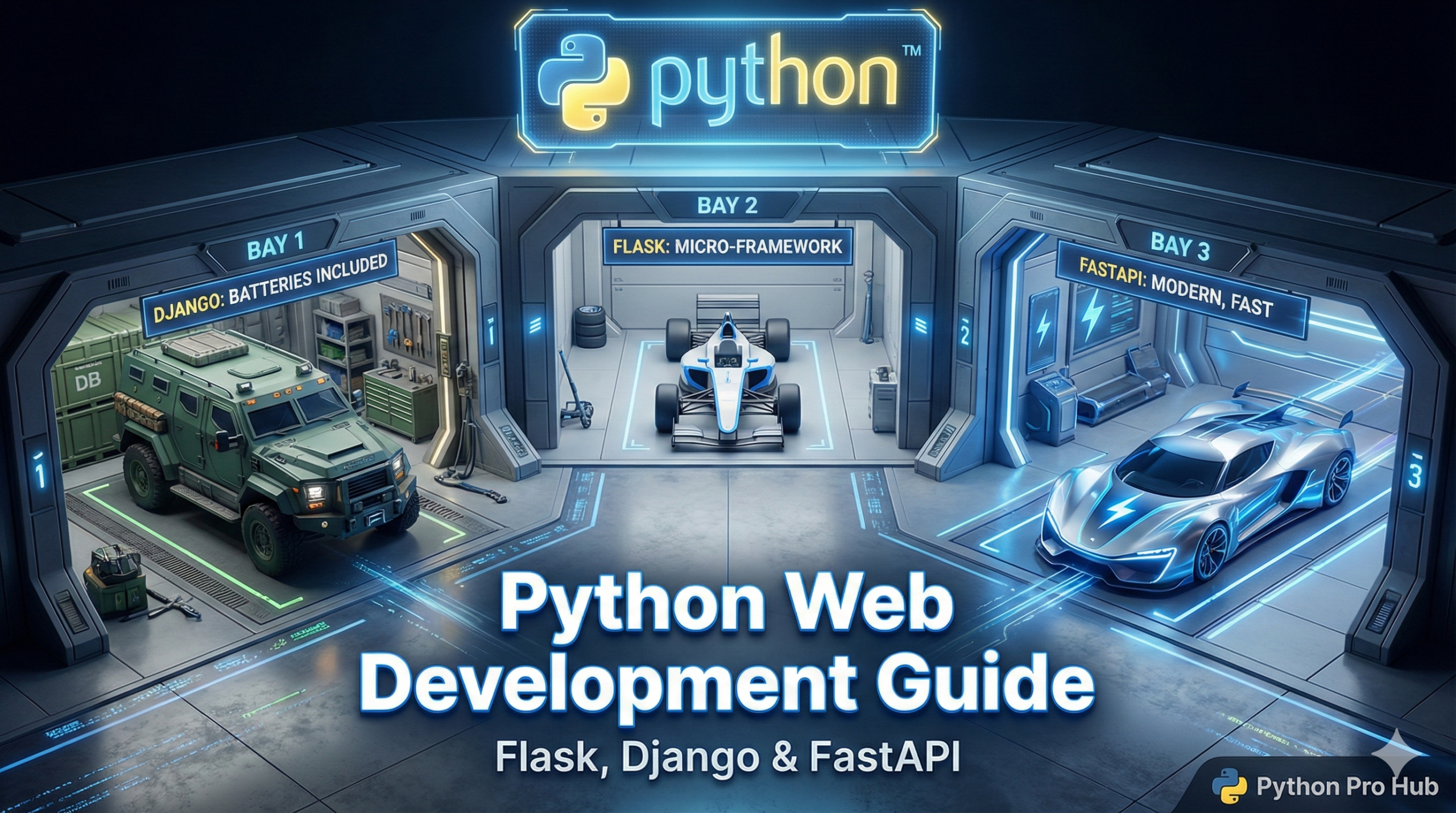
Python Web Development Guide: The Web is Your Frontier
When people think of Python, typically they think of data science or scripting. However, Python is an absolute powerhouse for web development, running the backends of massive sites like Instagram, Spotify, and Netflix.
If you’ve mastered the basics (functions and data structures), the web is your next step. But getting started is confusing because you hear three names everywhere: Django, Flask, and FastAPI.
Therefore, this guide is your new “Hub.” We will compare them, tell you what each is for, and help you choose your path.
What is a “Web Framework”?
You could build a website using only Python, but you’d have to manually handle thousands of tasks: parsing HTTP requests, routing URLs, connecting to databases, and protecting against hackers.
Consequently, a Web Framework is a pre-built set of tools that handles all that “plumbing” for you. This allows you to focus on building your app’s unique features. Let’s meet the big three.
🏗️ 1. Django: The “Batteries-Included” Behemoth
Django is the oldest, most mature, and most famous Python framework. Fundamentally, its philosophy is “batteries-included,” which means it comes with everything you need right out of the box.
Use Django when: You are building a large, complex application (E-commerce, Social Network) and want security and an admin panel immediately.
Core Django Skills
- Project Setup: Start here. First, set up a professional Django project structure and understand the file layout. [ Django for Beginners: How to Set Up Your First Project (2026) ]
- The Admin Panel: The killer feature. Specifically, learn how to manage your database content without writing a single line of frontend code. [ Django Admin Project: How to Add Custom ‘Actions’ (Export to CSV) ]
Advanced Architecture
- The ORM: Stop writing raw SQL. Instead, use the Django ORM to interact with your database using Python classes. [ Django Models: Introduction to Databases and ORM ]
- Authentication: User management is hard. Fortunately, Django makes it easy. Learn to handle logins, permissions, and groups. [ Django User Authentication: Registration, Login, and Logout Guide ]
- Pagination: Handling large lists? Learn how to break data into pages to keep your site fast. [ How to Add Pagination to Your Django ListView (The Easy Way) ]
🧪 2. Flask: The “Micro-Framework”
Flask is the complete opposite of Django. In contrast, its philosophy is to give you the absolute bare minimum to get a web server running. You choose the tools you want.
Use Flask when: You are learning, building a small prototype, or need a simple wrapper for a Machine Learning model.
Flask Fundamentals
- Hello World: Your first steps. Simply build a “Hello World” site in under 5 minutes. [ Your First Flask App: Building a “Hello, World” Website in 5 Minutes ]
- Templates: Dynamic content. Specifically, learn how to use Jinja2 templates to insert Python variables into HTML. [ Flask for Beginners: Understanding Routes and HTML Templates ]
AI Integration
- Model Deployment: Simplicity for AI. In this guide, we show how to wrap a fine-tuned model in a Flask API for rapid testing. [ AI Project: Deploy Your Fine-Tuned Model with Flask ]
⚡ 3. FastAPI: The “Modern API” Builder
FastAPI is the new star. Currently, it is built on modern Python features (like type hints) and is one of the fastest frameworks available, rivaling NodeJS and Go.
Use FastAPI when: You are building an API (backend) for a mobile app or a React frontend. It validates data automatically and runs tasks asynchronously.
High-Performance APIs
- Async Speed: The modern standard. Learn why FastAPI is replacing Flask for high-performance APIs. [ Python Web Dev: Build Your First High-Performance API with FastAPI ]
- API Gateways: Security first. Therefore, build an API Gateway that validates requests before they reach your backend. [ The API Gateway: Building the Entry Point with FastAPI ]
AI & Async Tools
- Model Serving: Integrate AI. Specifically, we show you how to wrap a Hugging Face model in an asynchronous API. [ AI Project: Deploying Hugging Face with FastAPI for Async Speed ]
🗄️ 4. The Backend Architecture (Databases & DevOps)
A framework is useless without a solid backend architecture. Ultimately, these tools connect your code to the real world.
Database Management
- PostgreSQL: Scale up. Eventually, you must transition from SQLite to a production-ready PostgreSQL database in the cloud. [ Python Cloud Project: Connect Python to a Real PostgreSQL Database ]
- Design Patterns: Clean code. Start by implementing the Repository Pattern to decouple your database logic from your API. [ The Repository Pattern: Decoupling Your Capstone from the Database ]
Scalability & Tools
- Background Tasks: Heavy lifting. For performance, use Celery and Redis to handle background tasks so your website doesn’t freeze. [ Asynchronous Task Queues: Connecting Python to Redis and Celery ]
- PyScript: Frontend in Python? Surprisingly, you can build a dashboard using PyScript directly in the browser. [ PyScript Project: Build a Full Data Dashboard (API + Pandas + Plot) ]
| Feature | Django | Flask | FastAPI |
| Philosophy | “Batteries-Included” | “Micro-framework” | “Modern API-first” |
| Best For… | Large, complex websites | Small sites, microservices | High-performance APIs |
| Learning Curve | High | Low | Low-Medium |
| Database ORM | Built-in (Powerful) | You Add It (SQLAlchemy) | You Add It (SQLAlchemy) |
| Admin Panel | Built-in (Automatic) | No (You build it) | No (You build it) |
| Auto-Docs | No | No | Yes (Its best feature) |
🏁 My Recommendation
- Want to build a traditional website (like a blog, e-commerce store, or SaaS)? Start with Django. The learning curve is worth it for the Admin panel alone.
- Want to build a high-speed API for a mobile app or AI service? Start with FastAPI. It is the future of Python backends.
- Want to learn the basics or build a quick prototype? Start with Flask. It gets out of your way.