
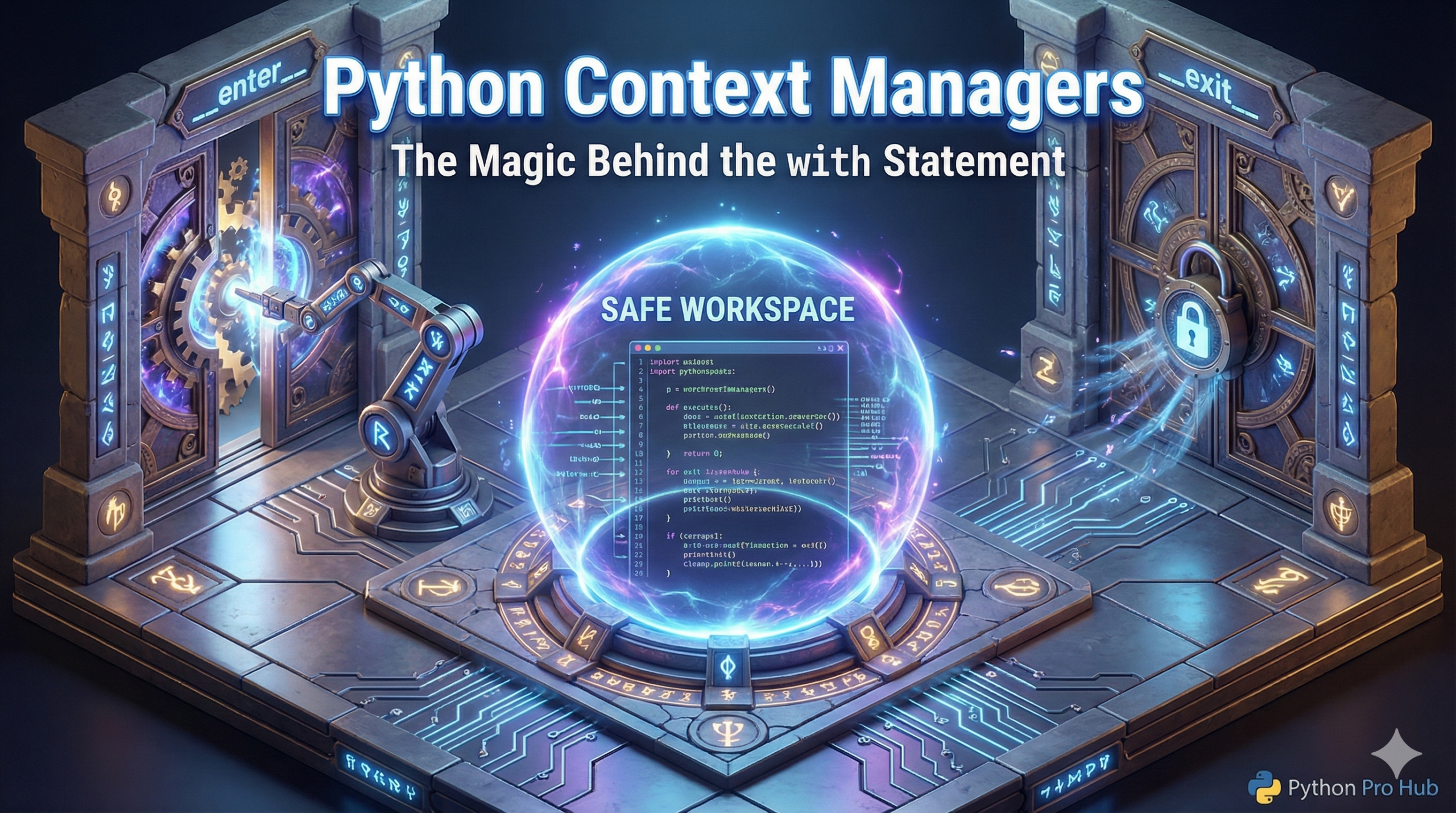
You already use them all the time: Python Context Managers.
with open("data.txt", "r") as f:
    data = f.read()
This with block is a Context Manager. It guarantees that f.close() is called when the block ends, even if an error occurs.
How It Works (Under the Hood)
A context manager is just a Python class with two special methods:
__enter__: Runs when you enter thewithblock.__exit__: Runs when you leave thewithblock.
Method 1: The Class-Based Approach (For Control)
Let’s build a Timer that measures code performance. We will update it so you can access the data afterwards.
import time

class Timer:
    def __enter__(self):
        self.start = time.time()
        return self  # This returns the instance to 'as t'

    # The arguments here capture any error that happened inside the block
    def __exit__(self, exc_type, exc_val, exc_tb):
        self.end = time.time()
        self.duration = self.end - self.start

        # If an error occurred, we can log it here
        if exc_type:
            print(f"An error occurred: {exc_val}")

        # Return False to let the error propagate (crash), True to suppress it
        return False

# Using it
with Timer() as t:
    for i in range(1000000):
        pass

print(f"That took {t.duration:.4f} seconds.")
Method 2: The “Lazy” Way (For Speed)
Writing a whole class just to time a script is verbose. Python’s contextlib module lets you use a generator to do the same thing in half the lines.
Everything before the yield is the setup (__enter__), and everything after is the teardown (__exit__).
from contextlib import contextmanager
import time

@contextmanager
def simple_timer():
    start = time.time()
    try:
        yield # Control is handed to the 'with' block here
    finally:
        # This runs after the block finishes
        end = time.time()
        print(f"Elapsed time: {end - start:.4f} seconds")

# Usage
with simple_timer():
    time.sleep(1)
Which one should you use?
- Use the Class approach when you need to manage complex state or handle specific exceptions logically.
- Use the
@contextmanagerdecorator for simple resource management (like timers, temporary file changes, or locks).
Key Takeaways
- Python Context Managers use the ‘with’ block to ensure resources are properly managed, such as calling f.close().
- They consist of a class with two methods: __enter__ for setup and __exit__ for teardown.
- You can create a Timer using a class for detailed performance measurements.
- Alternatively, the ‘contextlib’ module allows for faster context managers using a generator with the @contextmanager decorator.
- Choose the class approach for complex states, and the generator for simpler tasks like timers or temporary changes.