You’ve learned functions, loops, and variables. You can write scripts. But to build large applications (like with Django), you need a better way to organise your code. This Python OOP Guide will help you learn how to structure your programs effectively.
OOP is a way of modeling code after real-world things. This guide will walk you through creating “Objects” that have their own data and behaviours.
The Core Concept: Class vs. Object
Understanding the class versus object is essential in any Python OOP Guide.
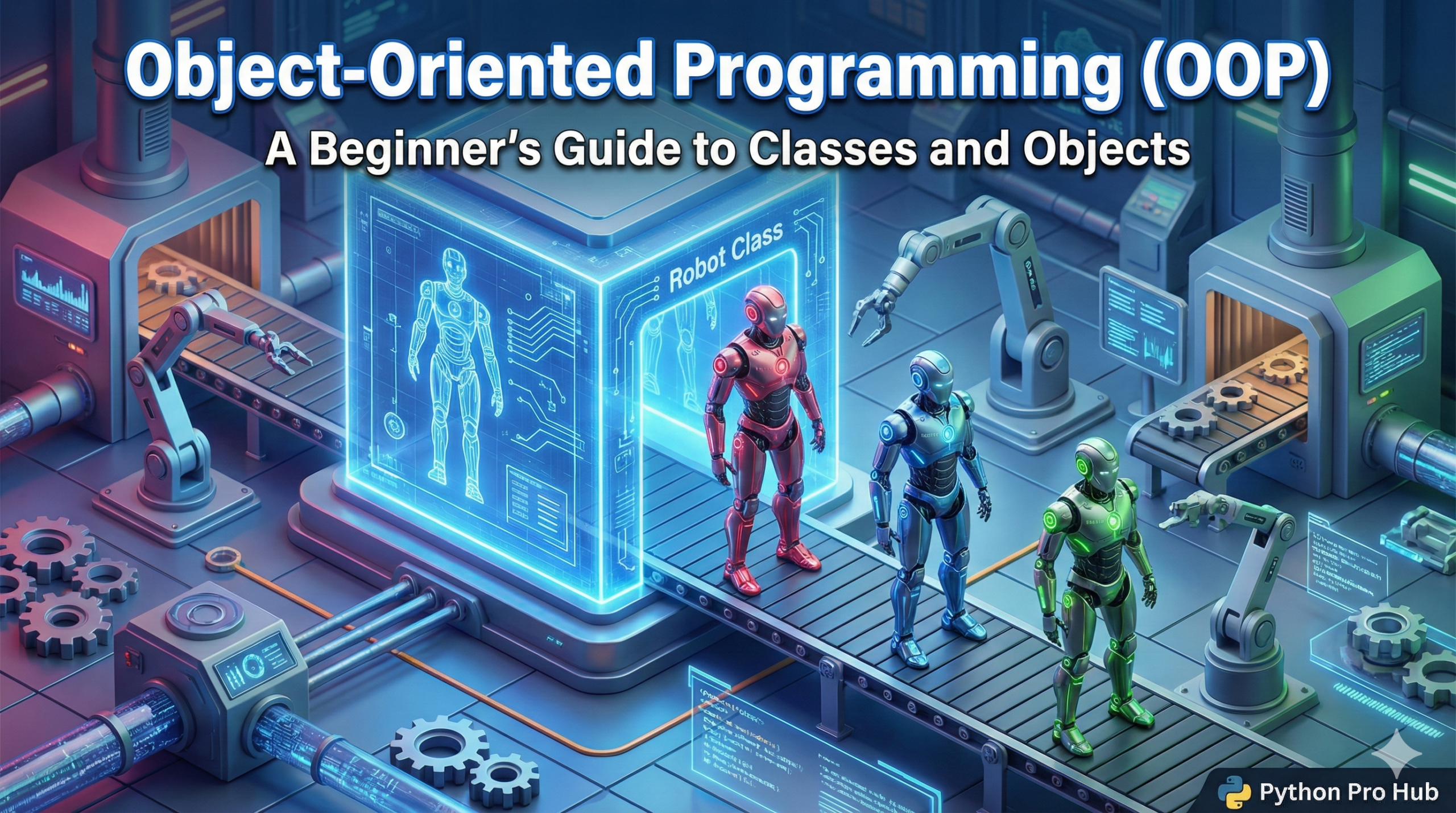
- Class (The Blueprint): Think of a blueprint for a house. It defines where the walls go and how big the kitchen is. But you can’t live in a blueprint. This analogy is crucial to follow along with the Python OOP Guide.
- Object (The House): This is the actual thing built from the blueprint. As detailed, you can build many identical houses from one blueprint.
In Python, we write the Class (blueprint) once, and then create many Objects (instances) from it.
Writing Your First Class
Let’s model a Dog. What does every dog have? This is a key point of the Python OOP Guide.
- Data (Attributes): Name, Age, Breed.
- Behaviours (Methods): Bark, Eat, Sleep.
class Dog:
    # The "Constructor" method.
    # This runs automatically when you create a new Dog.
    def __init__(self, name, age):
        self.name = name  # Save the name to THIS particular dog
        self.age = age    # Save the age to THIS particular dog

    # A standard method (behavior)
    def bark(self):
        print(f"{self.name} says Woof!")
What is self?
You see self everywhere in Python classes. self just means “THIS specific object.” When Fido barks, he needs to know his own name, not Spot’s name. self.name allows him to find it.
Using the Class (Creating Objects)
Now we can create as many dogs as we want from our blueprint.
# Create two different dog objects
dog1 = Dog("Fido", 3)
dog2 = Dog("Spot", 5)

# Access their attributes
print(dog1.name)  # Output: Fido
print(dog2.age)   # Output: 5

# Call their methods
dog1.bark()  # Output: Fido says Woof!
dog2.bark()  # Output: Spot says Woof!
Why Use OOP?
It keeps related data and functions together, which explains thoroughly. Without OOP, you’d have unrelated lists like dog_names = [] and dog_ages = [], which gets messy fast.