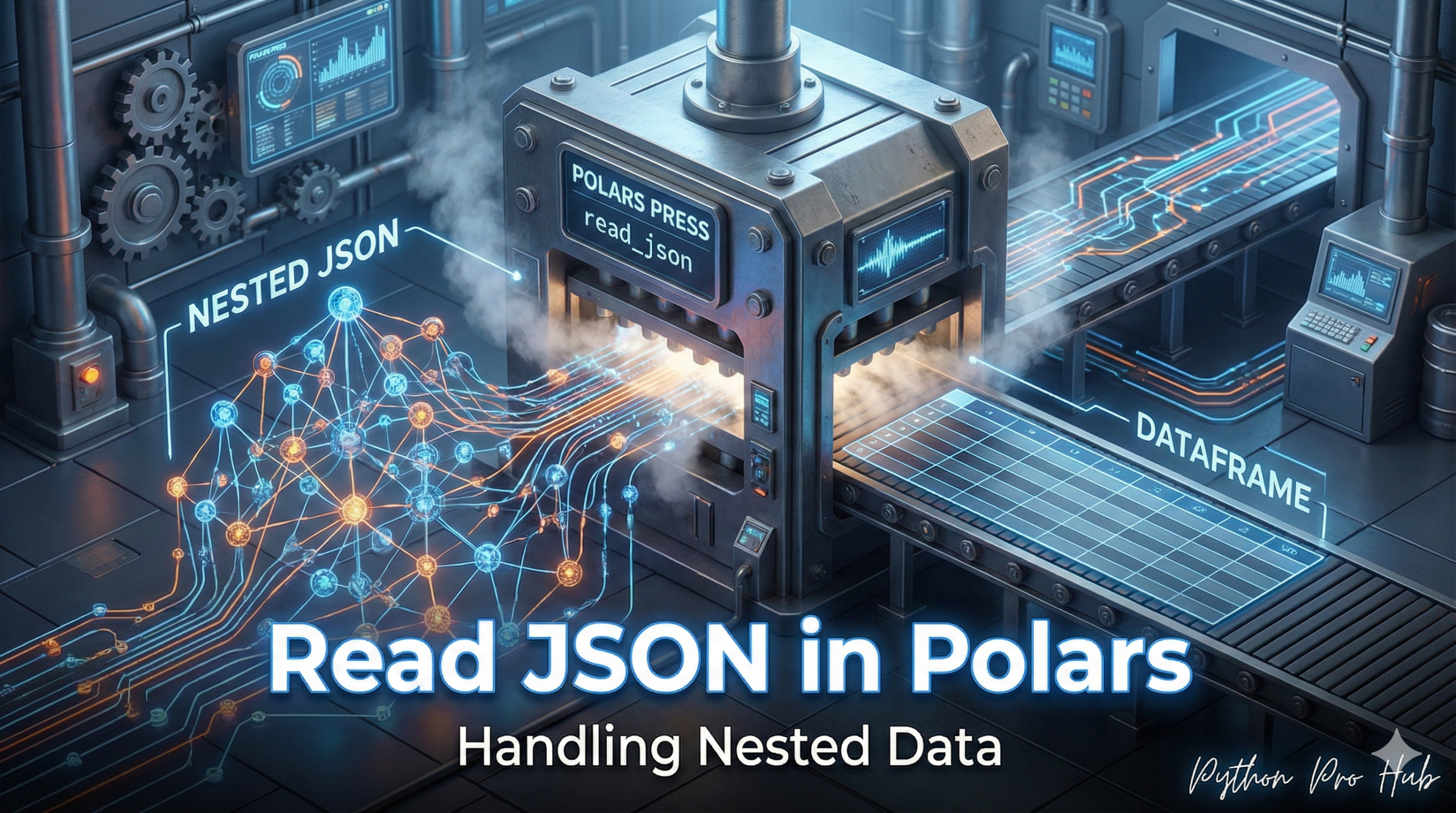
You’ve learned to read CSVs, Parquet, and Excel. But many APIs and modern databases (like MongoDB) output JSON files. In this tutorial, you’ll learn how to use Polars read_json to handle JSON data efficiently.
Polars can read JSON directly into a DataFrame. It’s important to know which kind of JSON you have.
1. Standard JSON (An Array of Objects)
This is the most common format: a single file containing a big list.
data.json:
[
  {"id": 1, "name": "Alice", "city": "New York"},
  {"id": 2, "name": "Bob", "city": "London"}
]
The Code:
import polars as pl

# read_json handles this format perfectly
df = pl.read_json("data.json")
print(df)
2. JSONL (JSON Lines / Newline-Delimited)
This format is much better for big data. Each line is its own, complete JSON object. data.jsonl:
{"id": 1, "name": "Alice", "city": "New York"}
{"id": 2, "name": "Bob", "city": "London"}
The Code: pl.read_json is smart and handles this format automatically!
df_jsonl = pl.read_json("data.jsonl")
print(df_jsonl)
Output (for both):
shape: (2, 3)
┌─────┬───────┬──────────┐
│ id  ┆ name  ┆ city     │
│ --- ┆ ---   ┆ ---      │
│ i64 ┆ str   ┆ str      │
╞═════╪═══════╪══════════╡
│ 1   ┆ Alice ┆ New York │
│ 2   ┆ Bob   ┆ London   │
└─────┴───────┴──────────┘
This pairs perfectly with Polars’ advanced nested data and JSON namespace tools for further cleaning.
Key Takeaways
- You can use Polars to read JSON files directly into a DataFrame, but you need to know the specific format.
- Standard JSON consists of an array of objects, while JSONL (Newline-Delimited) is better for large datasets.
- Polars handles JSONL automatically with the function pl.read_json, making it efficient for big data tasks.
- Both formats work well with Polars’ advanced tools for handling nested data and JSON namespaces.